GRHF and Aspirus Ironwood Hospital Partner to Support Expecting Families and the Rx Kids Program

FOR IMMEDIATE RELEASE – JULY 23, 2026 

IRONWOOD, MI – Aspirus Ironwood Hospital and the Gogebic Range Health Foundation (GRHF) have announced a joint initiative to strengthen support for expecting and new parents across Michigan’s Upper Peninsula. The partnership grew out of GRHF’s ongoing advocacy for expecting families in Gogebic County and the surrounding region. 

As part of that advocacy process, GRHF worked with Aspirus Ironwood Hospital to identify meaningful ways to support local families. That collaboration resulted in a $28,855 donation from Aspirus Ironwood Hospital, flowing through GRHF to the Superior Health Foundation – which serves as the fiduciary for the Rx Kids fund for the Upper Peninsula – as well as the development of a new resource guide for expecting and new parents. 

Rx Kids, a program developed by Michigan State University, provides direct cash support to pregnant mothers and new parents, $1,500 prenatally and $500 per month for the first six months of a baby’s life. The program recently expanded to cover all 15 counties of Michigan’s Upper Peninsula. Given the added costs families now face, including transportation to out-of-area birthing facilities, groceries, and newborn essentials, Rx Kids offers critical, flexible support at a time when it is needed most. 

The new expecting families resource guide, developed jointly by Aspirus Ironwood Hospital and GRHF, helps families navigate the full range of services available throughout pregnancy and early parenthood, from prenatal care and financial assistance to community health programs and beyond. It is available at gogebicrangehf.org under the Community tab. 

“We are deeply committed to the health and well-being of every family in our community,” said Rae Kaare, VP- Chief Administrative Officer of Aspirus Ironwood Hospital. “This partnership with the Gogebic Range Health Foundation allows us to make a meaningful impact on the lives of parents and children across the Upper Peninsula. We are proud to help bring Rx Kids’ resources to our region and to ensure expecting families have the information they need to plan for their care throughout pregnancy, labor and delivery, and beyond.” 

“GRHF has a firm commitment to advocate for local families and find constructive ways to address challenges in our community,” said Kassi Huotari, Executive Director of the Gogebic Range Health Foundation. “Working with Aspirus, we were able to turn that advocacy into real, tangible support via a donation that will directly benefit families in Gogebic County through Rx Kids, and a resource guide that ensures families and those planning to start a family now have the tools and resources to pursue a safe, supported pregnancy and a strong start postpartum.” 

Families who are expecting or have a baby born March 1, 2026 or later and reside in any of the U.P.’s 15 counties are encouraged to apply at rxkids.org/communities/gogebic-county.

About Rx Kids 

Rx Kids is the nation’s first community-wide prenatal and infant cash support program, developed by Michigan State University’s College of Human Medicine. The program provides $1,500 to expecting mothers and $500 per month for the first six months of a baby’s life, and is now available across all 15 counties of Michigan’s Upper Peninsula. For more information, visit RxKids.org. 
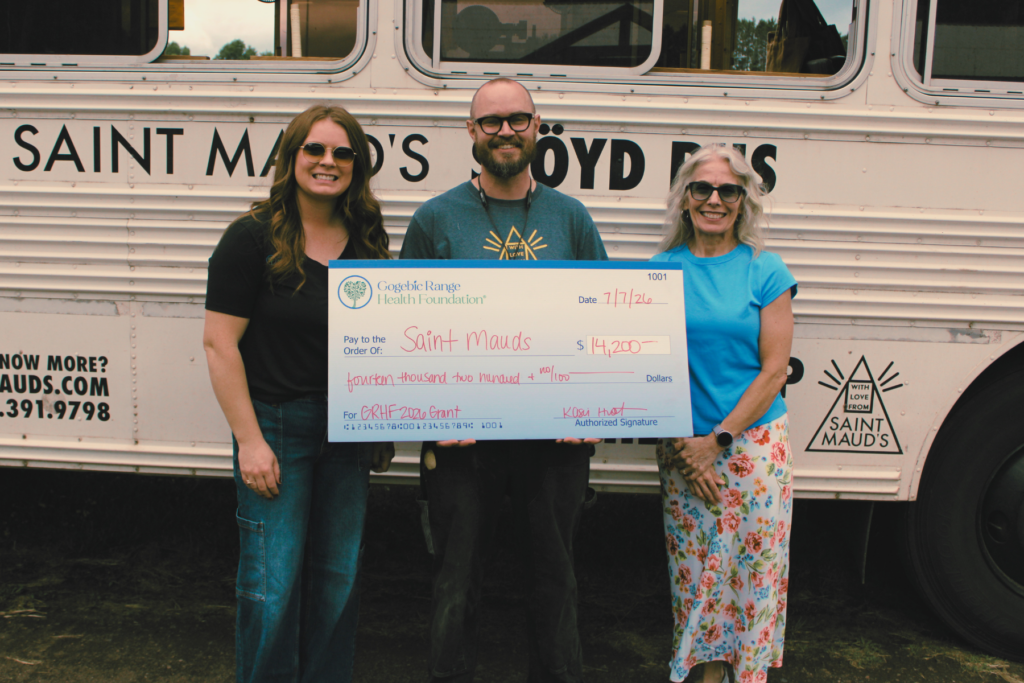
The Gogebic Range Health Foundation presents a check for a $14,200 grant to Saint Mauds as part of GRHF’s 2026 Community Health Grant Round. Pictured Above (L to R): Kassi Huotari; Executive Director, GRHF, Karl Zinsmaster; Saint Mauds, and Lori Booth; Board Chair, GRHF

Ironwood, MI – July 2026 — The Gogebic Range Health Foundation (GRHF) has awarded $41,700 to 8 local organizations through its 2026 Community Health Grant cycle, supporting youth engagement, mental health, community food systems, and connected communities across the Gogebic Range. This cycle drew over $117,000 in requests for $35,000 available, and GRHF was able to utilize some additional funding from the Jonathan A. Erickson Fund to grants aligned with mental health initiatives.

2026 Grant Recipients:

  • Saint Mauds – $14,200 – Summer 2026 Sloyd woodworking programming for youth
  • Big Brothers Big Sisters of the Western U.P. – $5,500 – Summer staffing to rebuild mentoring capacity
  • Communities That Care Coalition – $4,000 – Youth and family engagement programming
  • Gogebic Community College – $5,500 – Mental health programming for students and community
  • Wakefield-Marenisco School District – $2,500 – Snowshoe equipment and transportation for outdoor recreation
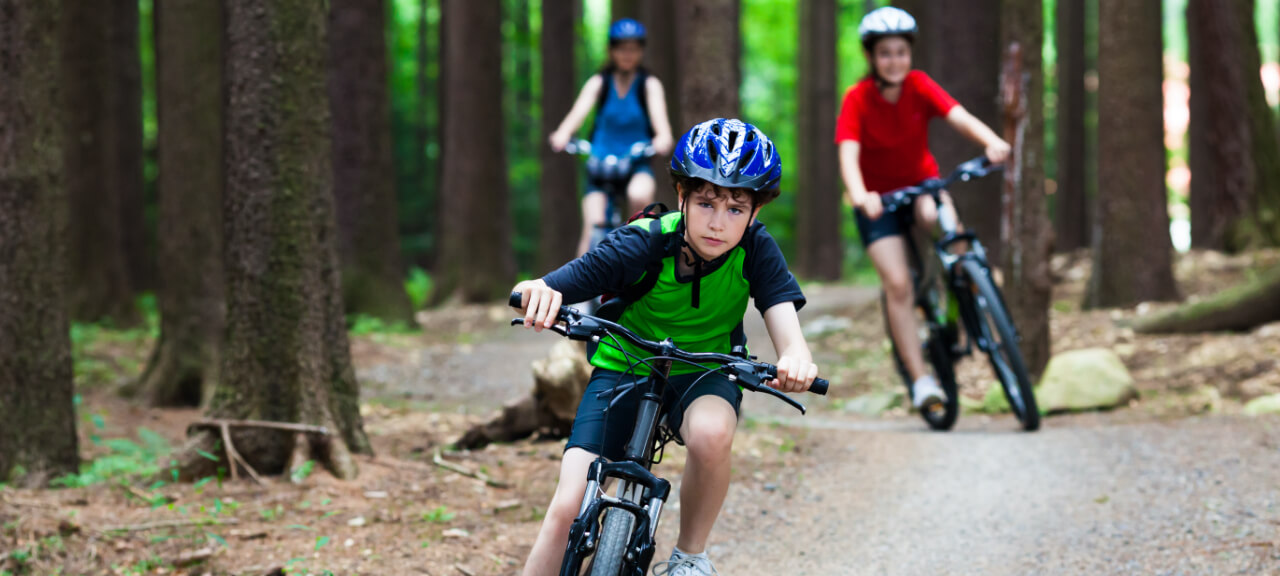
  • SISU Dirt Crew – $4,000 – Beginner mountain bike trails near Ironwood School
  • Historic Ironwood Theatre – $3,500 – Youth Theater Workshop
  • Ironwood Area Schools – $2,500 – Camp Nesbitt outdoor education program

“Every year, our grantees show us what’s possible when a community invests in itself,” said Kassi Huotari, Executive Director of GRHF. “This year’s awardees represent everything from youth engagement to organizational capacity – a real snapshot of what our region needs right now.”

GRHF has invested more than $1 million in the Gogebic Range since its founding in 2015, serving Iron County, WI and Gogebic County, MI.

Media Contact:
Kassi Huotari, Executive Director
kassi.huotari@gogebicrangehf.org | 906-364-7527 | gogebicrangehf.org

FOR IMMEDIATE RELEASE – April 8, 2026 – The Gogebic Range Health Foundation (GRHF) is exploring the potential for a multi-location, collaboratively programmed community center to expand access to sports, recreation, health, wellness, and social programming across Gogebic County. The project would leverage existing facilities through shared programming, staffing, transportation, and funding. While no decisions have been made on construction, location, or operations, the initiative is focused on learning from the community to guide future strategies.

Over the past several months, GRHF’s Community Center Planning Team (CCPT) has conducted 10–12 focus groups with residents to better understand needs, service gaps, and barriers to access. “This project is incredibly exciting and energizing,” said Robert Brown, media contact for the CCPT. “The passion and dedication throughout the group is inspiring. The steering committee is actively working through challenges unique to Gogebic County, such as transportation and accessibility, to ensure any future plan serves all residents and is collaborative.”

The CCPT steering committee includes leaders from local government, education, healthcare, and community organizations, including Robert Brown, Yvonne Clark, Megan Hagen, Tom Bergman, Noah Hofstede, Klaus Kutschke, Yolanda Lozano, Suzanne Toth, Ashley Tarro, Lynne Wiercinski, Kassi Huotari, and Will Andresen. 

This project, funded by a Rural Readiness Grant through the Michigan Office of Rural Prosperity, reflects GRHF’s commitment to engaging the community and exploring innovative approaches to meet the unique needs of the Gogebic Range.

GRHF is also seeking additional input from the general public. Community members are encouraged to complete a brief survey at gogebicrangehf.org/survey or by scanning the QR code. Paper copies of the survey are available at the Ironwood Carnegie Library and the Watersmeet Township Building during regular business hours.

If you are unable to access either location or need assistance completing the survey, please email info@gogebicrangehf.org or call 906-364-7527 to coordinate accommodations.

For more information, contact:
Robert Brown, CCPT Media Representative
Email: citymanager@cityofwakefieldmi.gov

About the Gogebic Range Health Foundation
The Gogebic Range Health Foundation serves to advance community health throughout the Gogebic Range, including Iron County, WI and Gogebic County, MI, and to establish the Gogebic Range as a fun and healthy place to live.

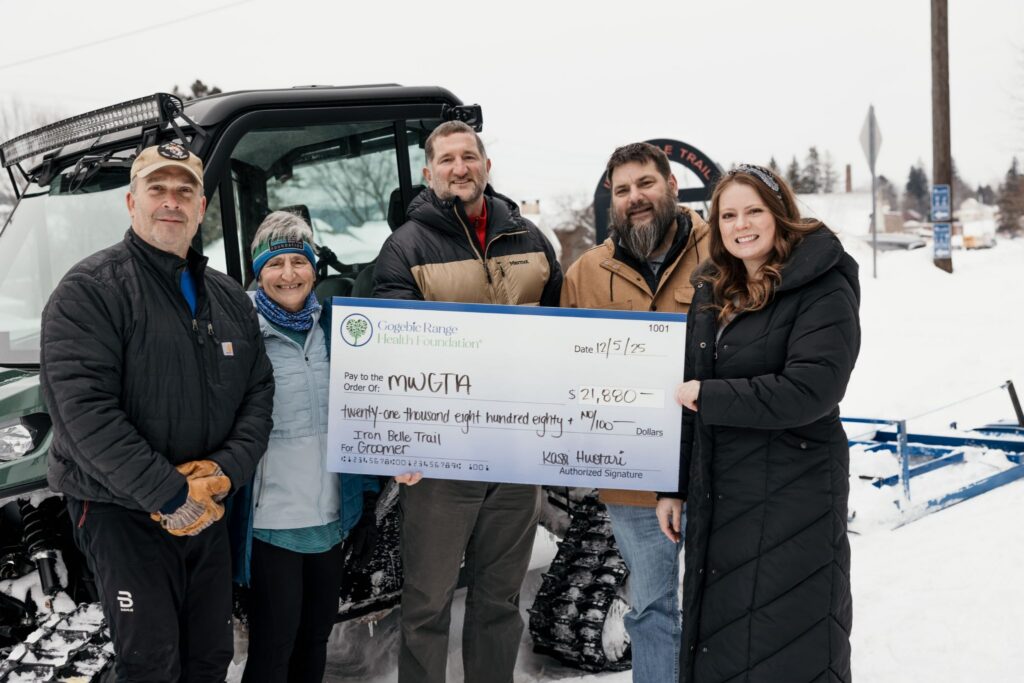
Pictured from left to right at the check presentation are Randy and Mary Ahnen (MWGTA), Paul Anderson (President, MWGTA), Neil Klemme (Vice Chair, GRHF), and Kassi Huotari (Executive Director, GRHF).

Bessemer, MI – December 5, 2025 — The Gogebic Range Health Foundation (GRHF) is proud to support Michigan’s Western Gateway Trail Authority (MWGTA) in its successful effort to raise funds toward the purchase of a new groomer for the Iron Belle Trail.

Through a collaborative spring fundraising initiative, MWGTA sold 300 raffle tickets at $100 each, offering eight cash prizes totaling $10,000. After expenses, the raffle generated $19,880 in proceeds dedicated to the groomer purchase. GRHF amplified this community-driven effort by providing a $2,000 raffle match.

On Friday, December 5, GRHF presented MWGTA with a check in the amount of $21,880, representing the raffle proceeds plus the Foundation’s matching contribution.

“This was a great example of how community-led fundraising, paired with strategic philanthropic support, can move important projects forward,” said Kassi Huotari, Executive Director of the Gogebic Range Health Foundation. “The Iron Belle Trail is a great asset for outdoor recreation, tourism, and overall community health and well-being, and we’re proud to support MWGTA’s work to maintain and enhance it.”

The Iron Belle Trail plays a vital role in promoting physical activity, outdoor access, and economic vitality throughout the community.

The Gogebic Range Health Foundation serves to advance community health throughout the Gogebic Range which includes Iron County, WI and Gogebic County, MI, and to establish the Gogebic Range as a fun and healthy place to live.

For more information about GRHF and its community investments, visit gogebicrangehf.org/past-projects.

The Gogebic Range Health Foundation (GRHF) is proud to announce the recipients of its 2025 Community Health Grants, awarding $41,995 to 12 local organizations that are advancing health, wellness, and resilience across the Gogebic Range. This milestone year marks GRHF’s 10th anniversary and celebrates the Foundation’s commitment to investing in the people and places that make our region thrive — now with more than $1 million granted since inception.

Grants were awarded to organizations whose projects align with GRHF’s core funding priorities: youth engagement and mental health, economic empowerment, community food systems, and connected communities. Funding decisions were made through a competitive grant cycle with an emphasis on impact, collaboration, and community benefit.

2025 Community Health Grant Recipients

Jonathan Erickson Mental Health Fund:
906 Adventure Team – $1,000 –  Supporting youth outdoor programs through team supplies and healthy snacks.

UW-Madison Division of Extension, Iron County – $4,000 – Supporting youth engagement and health education initiatives regarding vaping.

Community Health Grants:
Bessemer Science Olympiad – $1,000 –  Supporting STEM learning and team-based science competition opportunities for middle and high school students in the Bessemer School District.

Emberlight Festival – $4,995 –  Enhancing accessibility for community arts and cultural events.

Gogebic-Ontonagon Community Action Agency – $10,000 –  Sustaining essential meal services for older adults in the region.

Gogebic Range Farmers Market Association – $2,000 – Enhancing local food systems by strengthening community farmers markets and increasing access to fresh, locally grown produce.

Mercer Area Food Pantry – $4,000 – Providing fresh produce to improve food access for local seniors.

Mercer Health & Wellness, Inc. – $6,000 – Improving a community garden to support health and sustainability.

Michigan’s Western Gateway Trail Authority/City of Bessemer
– $2,000 – Improving trail maintenance and year-round recreational access through a raffle match.

Northwind Natural Food Co-op – $3,000 – Partnering to provide healthy, local food education and access initiatives through collaborative outreach and food-based programming.

Red Devil Education Foundation – $2,000 –  Promoting physical activity and wellness among students.

Watersmeet Township
– $2,000 – Expanding food delivery and wellness services for rural seniors.

A Decade of Impact

Founded in 2015, the Gogebic Range Health Foundation was created to support initiatives that improve the health and vitality of Iron County, Wisconsin and Gogebic County, Michigan. In just ten years, the Foundation has invested over $1 million in regional projects that serve youth, promote well-being, and build healthier, more connected communities.

“We are incredibly proud of what our grantees are doing to lift up the Gogebic Range,” said Kassi Huotari, Executive Director of GRHF. “This year is especially meaningful, as we reflect on a decade of community investment and look ahead to an even more vibrant, resilient future.”

The 2025 grants were distributed at a media event on May 28 at Stormy Kromer in Ironwood, where grantees gathered for recognition and photos alongside GRHF staff and board members.

About the Gogebic Range Health Foundation

The Gogebic Range Health Foundation improves the well-being of individuals and families by addressing the unique challenges of our community and supporting initiatives that foster resilience and growth. The Foundation serves the Gogebic Range — including Iron County, WI and Gogebic County, MI — and is committed to making the region a fun and healthy place to live.

For more information, visit gogebicrangehf.org or follow GRHF on Facebook and Instagram.

Media Contact:
Kassi Huotari
Executive Director, Gogebic Range Health Foundation
kassi.huotari@gogebicrangehf.org
906-364-7527
gogebicrangehf.org

February 27, 2025 – Ironwood, Michigan – The Gogebic Range Health Foundation is excited to announce that it has been awarded a planning grant through the Michigan Rural Readiness Grant Program to develop a comprehensive plan for a multi-purpose community center in Gogebic County, in partnership with the City of Ironwood and with support from many local community organizations, businesses, government officials, and leaders. The $50,000 grant will support the early stages of the project, which will assess the community’s needs, including an evaluation of community health, and determine the best strategy for creating a sustainable and impactful center.

In January 2025, the Gogebic Range Health Foundation reached a significant milestone, surpassing $1 million in giving. As we approach our 10-year anniversary in July 2025, this is an especially timely moment for the Foundation to assist our community with this important project. A multi-purpose community center aligns with our mission to improve the well-being of individuals and families by addressing the unique challenges of the community, including but not limited to, childcare shortages, economic disparities, and gaps in services.

At this stage, no decisions have been made regarding the center’s location, services, or features. Over the next 16 months, the Foundation will work closely with local organizations, government officials, community members, youth, and other stakeholders to gather input and assess needs through surveys, focus groups, and other outreach efforts. This collaborative process will ensure that the center is designed to meet our community’s needs.

The Gogebic Range Health Foundation is committed to keeping the community informed and engaged throughout the planning process. We look forward to working with partners across sectors to develop a comprehensive plan that reflects the diverse needs of our region.

For more information about the project and the Rural Readiness Grant Program, visit the official announcement here.

For further inquiries, please contact Kassi Huotari, Executive Director of the Gogebic Range Health Foundation, at kassi.huotari@gogebicrangehf.org.

Public Radio 90, WNMU | By Nicole Walton | Published February 26, 2025 at 6:42 AM EST

LANSING, MI— Four Upper Peninsula organizations are benefitting from the state’s Rural Readiness Grant Program.

The money comes through the Michigan Department of Labor and Economic Opportunity’s Office of Rural Prosperity and is designed to help rural communities build capacity, drive economic development, and improve quality of life for residents.

Selected as grant recipients were:

  • Beaver Island Association – To develop a broadband development plan for Beaver Island to map out a fiber-to-the-home network, confirm build-out costs and establish a township-owned broadband system to provide reliable, high-speed internet access. ($43,000)
  • Eastern Upper Peninsula Intermediate School District – To assess regional mental health needs, engage community stakeholders and develop solutions to address gaps in support for students, particularly those experiencing severe post-COVID mental health challenges. ($50,000) 
  • Gogebic Range Health Foundation – To develop a comprehensive plan for a multi-purpose community center in Gogebic County to address childcare shortages, economic disparities and social service gaps through cross-sector collaboration and sustainable funding strategies. ($50,000) 
  • UPCAP Services – To support the establishment of a Veterans Assistance Fund to provide financial aid and services to veterans across Michigan’s Upper Peninsula, ensuring long-term sustainability through strategic planning, policy development and community partnerships. ($50,000) 

Projects funded through the Rural Readiness Grant Program will focus on key areas such as business development, broadband expansion, housing, workforce training, health and other initiatives that support long-term prosperity.

Link to this news article.

February 25, 2025 – LANSING, Mich. — Today, Gov. Gretchen Whitmer and the Michigan Department of Labor and Economic Opportunity’s (LEO) Office of Rural Prosperity announced the recipients of $1.3M in Rural Readiness Grant Program funding, a program designed to help rural communities build capacity, drive economic development and improve quality of life for residents.

The Rural Readiness Grant Program provides critical resources to communities that often face unique economic challenges, ensuring they have the support needed to attract investment, create jobs and foster sustainable growth. This funding will enable local governments, nonprofits and economic development organizations to implement projects that enhance infrastructure, build housing and health initiatives, expand workforce development programs and promote long-term economic success.

“Every Michigander deserves access to economic opportunity, no matter their zip code,” said Governor Gretchen Whitmer. “With the Rural Readiness Grant Program, we are helping communities across Michigan build the infrastructure, workforce, health services, housing and other amenities they need to grow and thrive. These investments make a real difference in people’s lives and will help us continue to make Michigan the best place to live, work and raise a family.”

“Governor Whitmer and I prioritize Michigan’s rural communities,” said Lt. Governor Garlin Gilchrist II. “These Rural Readiness Grants will help rural communities improve main streets, high speed internet access, housing, childcare, infrastructure and more. They are part of our commitment to grow Michigan’s rural economy, help more people succeed and build a bright future for rural residents. Let’s keep getting it done.”

Administered through LEO’s Office of Rural Prosperity, the Rural Readiness Grant Program aligns with the state’s commitment to ensuring all Michigan communities—regardless of size—have the tools needed to succeed in today’s economy.

“This funding helps level the playing field for rural communities, allowing them to compete for economic opportunities on equal footing with larger, urban areas,” said Susan Corbin, Director of the Michigan Department of Labor and Economic Opportunity. “By investing in local projects that address community needs like workforce, health, housing, infrastructure and economic development, we are ensuring every Michigander has access to the resources needed to reach their full potential.”

The following communities and organizations have been selected as grant recipients:

  • Beaver Island Association – Develops a broadband development plan for Beaver Island to map out a fiber-to-the-home network, confirm build-out costs and establish a township-owned broadband system to provide reliable, high-speed internet access. ($43,000)
  • Central Michigan University Rural Health Equity Institute – Integrates non-emergency medical transportation (NEMT) into rural EMS operations to improve healthcare access, reduce inappropriate EMS use and address transportation barriers for vulnerable rural populations. ($50,000)
  • Chamber Alliance of Mason County – Supports implementation of a five-year housing strategic plan and develops a strategy for soliciting developers to build on identified sites. ($50,000)
  • Develop Iosco – Expands grant writing capacity in Iosco and Alcona counties by providing workshops, research support and assistance to municipalities, businesses and nonprofits to help secure funding for critical community projects. ($50,000)
  • Eastern Upper Peninsula Intermediate School District – Assesses regional mental health needs, engages community stakeholders and develops solutions to address gaps in support for students, particularly those experiencing severe post-COVID mental health challenges. ($50,000)
  • Four County Community Foundation – Provides support for grant writing activities in a four-county region. ($50,000)
  • Gogebic Range Health Foundation – Develops a comprehensive plan for a multi-purpose community center in Gogebic County to address childcare shortages, economic disparities and social service gaps through cross-sector collaboration and sustainable funding strategies. ($50,000)
  • Hudson Area Schools – Conducts a feasibility study to determine the best use of a newly available 40-acre parcel in Hudson, developing a long-term plan to attract investment and support economic growth. ($50,000)
  • I69 Regional Development Corporation – Expands I-69 Regional Development Corporation’s technical assistance and revolving loan fund to support small business growth in underserved rural counties, increasing access to capital, fostering new partnerships and enhancing economic resilience. ($50,000)
  • Idlewild Community Alliance – Advances Idlewild’s revitalization by strengthening local governance, fostering leadership development, supporting small business growth and conducting a housing needs assessment to drive sustainable development. ($50,000)
  • InvestMitt Cooperative – Assists in establishing InvestMitt Cooperative, a community investment fund in Emmet and Charlevoix counties, enabling residents to pool resources, support attainable housing and attract additional investments to strengthen the regional economy. ($46,500)
  • Local Initiatives Support Corporation (LISC) – Strengthens rural Michigan communities by conducting needs assessments, enhancing cross-sector partnerships and providing assistance to address gaps in affordable housing, broadband and workforce development. ($50,000)
  • Manistee County Community Foundation – Expands the Manistee County Community Solutions Action Plan to strengthen childcare infrastructure, address regional childcare shortages and support policy updates that create a more childcare-friendly environment for families and providers. ($50,000)
  • Maslow’s Mount Pleasant Tiny Homes Village – Assists in the completion of essential zoning approvals and environmental assessments for a collaborative initiative that will provide stable housing and support services for individuals in need of transitional housing. ($33,800)
  • Michigan Center for Employee Ownership – Provides local stakeholders an understanding of the scope of impact of business ownership succession in their communities, builds skills to identify potential “at-risk” businesses, and offers tools and resources to guide business owners in starting the exit planning process to retain companies and jobs locally. ($50,000)
  • Mid-Michigan Community Action Agency – Supports Michigan Balance of State Continuum of Care (MIBOSCOC) in reassessing its governance and funding structure to enhance efficiency, secure diverse funding sources and sustain efforts to address homelessness in 61 rural counties. ($45,000)
  • Northeast Michigan Council of Governments (Land Bank) – Establishes a multi-county regional land bank and brownfield redevelopment strategy to address housing shortages, mitigate blight and support economic revitalization in underserved rural communities by streamlining property redevelopment and investment efforts. ($50,000)
  • Northern Lakes Economic Alliance – Launches a Regional Infrastructure and Development Readiness Initiative to assess infrastructure needs, prioritize development projects and attract public and private investment to strengthen the regional economy. ($44,000)
  • Northern Michigan Health Consortium – Expands the Community Connections Network’s data-sharing platform to improve care coordination, enhance social determinant tracking and integrate multiple health record systems, strengthening rural healthcare access and funding opportunities. ($50,000)
  • Region 2 Planning Commission – Establishes a gravel cycling initiative by creating Rural Recreation Hubs to support local economies and revitalize rural communities affected by population and income decline. ($40,000)
  • Shiawassee Family YMCA – Supports the Shiawassee Family YMCA’s expansion and renovation to address the county’s childcare shortage, create new jobs and enhance community engagement spaces, laying the foundation for long-term growth and support for working families. ($50,000)
  • Traverse Connect – Enhances grant readiness in the Grand Traverse Region by providing specialized training for local governments and organizations, increasing access to state and federal funding to support infrastructure, workforce and business development. ($50,000)
  • UPCAP Services – Supports the establishment of a Veterans Assistance Fund to provide financial aid and services to veterans across Michigan’s Upper Peninsula, ensuring long-term sustainability through strategic planning, policy development and community partnerships. ($50,000)
  • Village of Cassopolis – Advances the development of the Imagine Center in Cassopolis, a community hub focused on health, wellness, education and economic growth. ($50,000)
  • Village of Stockbridge – Develops a comprehensive mobility plan to enhance pedestrian safety, expand non-motorized transportation options, and improve access to essential services through sidewalk, bike lane and trail system improvements. ($40,000)
  • West Michigan Shoreline Regional Development Commission – Develops a West Michigan Agriculture Analysis. ($50,000)
  • Otsego Community Foundation – Conducts a feasibility study and housing development plan in Otsego County, aiming to create at least 50 attainable homes while engaging stakeholders to support zoning changes and future housing initiatives. ($50,000)

Projects funded through the Rural Readiness Grant Program will focus on key areas such as business development, broadband expansion, housing, workforce training, health and other initiatives that support long-term prosperity.

For more information about the Rural Readiness Grant Program and other efforts to support Michigan’s rural communities, visit Michigan.gov/ORP

Read this news article here.

Media Contact:
Chelsea Wuth
WuthC@michigan.gov

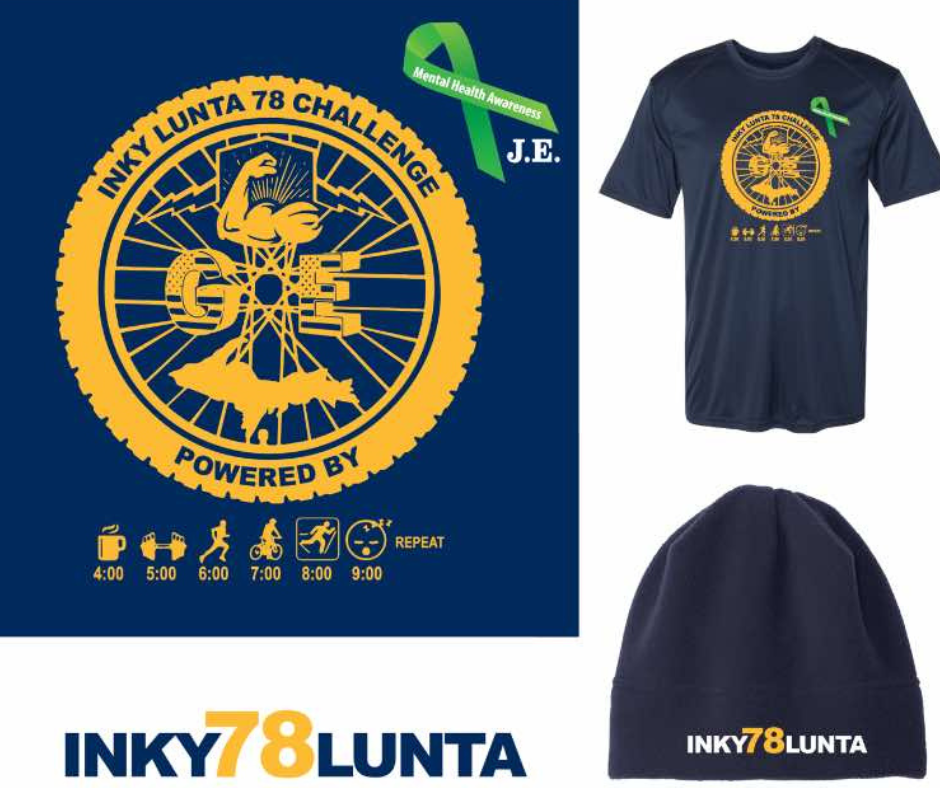
Ironwood, MI – January 13, 2025 – The Inky Lunta Committee, in collaboration with the Gogebic Range Health Foundation (GRHF), has announced the Inky Lunta 78 Challenge, an event honoring Ironwood’s legendary sportsman, coach, and fitness pioneer, Gary “Inky” Engstrom, and his close friend, Jonathan A. Erickson.

This year’s challenge celebrates what would have been Gary Engstrom’s 78th birthday, with participants taking on the theme of 78 in true Gary fashion: “Let’s do this—it’ll be fun!” Beginning on March 1, 2025, participants will engage in a 78-day journey of physical activity, selecting from one of the following challenges:

  • 78 minutes
  • 78 hours
  • 78 kilometers
  • 78 miles

Participants are encouraged to walk, run, roll, ski, paddle, strength train, or engage in other forms of activity to complete their goals. Proceeds from the event will benefit the Jonathan A. Erickson Fund, which supports mental health initiatives, as well as community health and wellness, through grant-making across the Gogebic Range.

Event Details:

  • Registration: Open now at runsignup.com/inkylunta78. The cost is $20 per challenge. Participants can add a T-shirt or fleece hat for $20 each. Log your activity each day.
  • Youth Event: Free to participate, with optional T-shirts and hats available for purchase.
  • Deadlines: T-shirt and hat orders must be submitted by February 16, 2025.
  • Kickoff Event/Tshirt/hat pick-up: Scheduled for March 1, 2025, at Cold Iron Brewery from 1-3pm.
  • Final Gathering Event: Will take place on May 2, 2025 (details to follow).

Donations to the Jonathan A. Erickson Fund can be made by check, payable to the Gogebic Range Health Foundation, and mailed to: E6112 Bluffview Rd, Ironwood, MI 49938.

For more information, visit runsignup.com/inkylunta78.

The Inky Lunta Committee and the Gogebic Range Health Foundation are excited to invite the community to participate in this meaningful event, continuing Gary Engstrom and Jonathan Erickson’s shared legacy of health, wellness, and community spirit.

Tshirt/Fleece Hat Mock-up

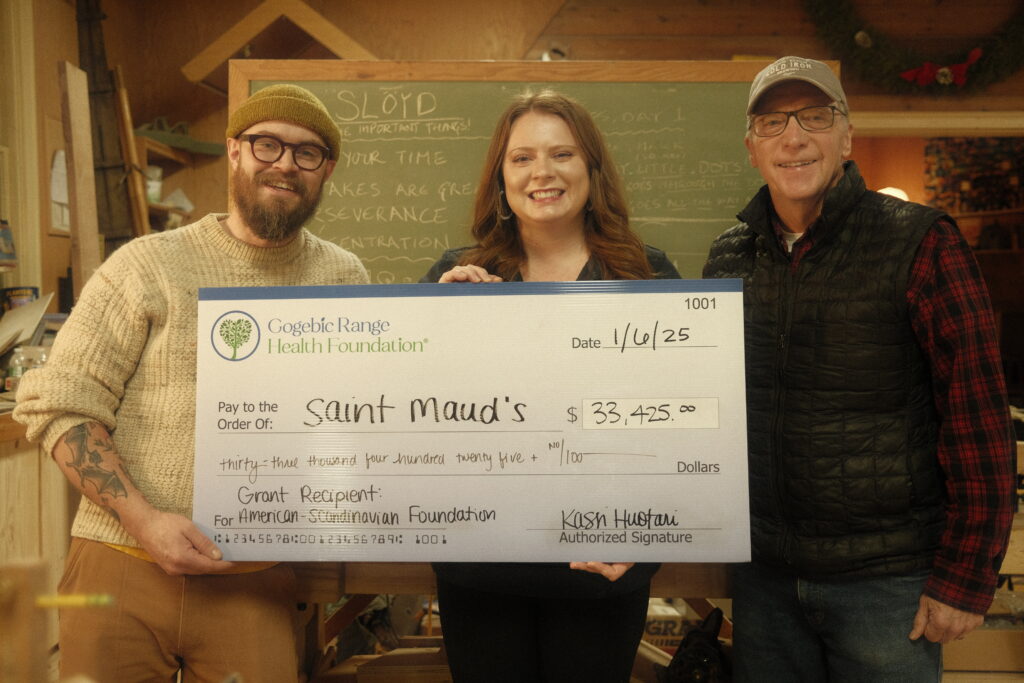
Pictured (L to R): Karl Zinsmaster of Saint Maud’s; Kassi Huotari and John Garske of GRHF

January 8, 2025 — The Gogebic Range Health Foundation (GRHF) is proud to announce and celebrate Saint Maud’s recent grant award from the American-Scandinavian Foundation! This significant funding will enable Saint Maud’s to expand and enhance its renowned Slöyd program, making its classes more accessible and impactful for local youth and families.

Thanks to this grant, Saint Maud’s will upgrade its equipment with the addition of a new four-person bench from Sjöbergs and another custom bench that is built in-house and designed by the Sloyd Experience. These enhancements will increase the program’s capacity to accommodate 16 participants, allowing more individuals to benefit from the hands-on craftsmanship, creativity, and character building fostered by the Slöyd program. Expanded offerings will reach local public school districts, the Superior Homeschool Co-op, and the program’s devoted community of families.

The funding will also support fair compensation for Saint Maud’s exceptional instructors and assistants, who are critical to the program’s ongoing success. Two new trainees—a work-study student from Hurley School District and a volunteer from Northland College—will join the team, bringing the total number of instructors to five. This investment in staffing will ensure the program’s continued excellence and growth.

“We’re thrilled to see Saint Maud’s Slöyd program flourish and to have supported them as their fiscal agent during their journey to achieving 501(c)(3) status,” said Kassi Huotari, Executive Director of GRHF. “Their commitment to fostering creativity and community is truly inspiring, and this grant marks an exciting new chapter in their growth.”

Saint Maud’s has been a pillar of creativity and education in the community, and this grant from the American-Scandinavian Foundation further solidifies their impact. Congratulations to Karl Zinsmaster and the entire Saint Maud’s team for this well-deserved recognition and support. GRHF and Saint Maud’s extends its gratitude to the American-Scandinavian Foundation for investing in this vital initiative. Together, we are building a brighter, more creative future for the Gogebic Range.

For more information about Saint Maud’s Slöyd program, please visit www.saintmauds.com.


About Saint Maud’s

Saint Maud’s is a community-based organization dedicated to fostering self-reliance, perseverance, concentration and love for labor through its Slöyd program. The program focuses on hands-on, project-based learning, teaching individuals of all ages the traditional Swedish craft of woodworking. With an emphasis on inclusivity, Saint Maud’s strives to make its programs accessible to all local youth and families, enriching the community with skills that promote creativity, critical thinking, and resilience. The organization continues to expand its offerings to better serve the Gogebic Range community.


About Gogebic Range Health Foundation

The Gogebic Range Health Foundation supports initiatives promoting health and wellness across Gogebic County, MI, and Iron County, WI. Its core funding priorities include youth engagement, economic empowerment, community food systems, and fostering connected communities. Learn more at gogebicrangehf.org

For more information, please contact:
Kassi Huotari
Executive Director | Gogebic Range Health Foundation
📞 906-364-7527
✉️ kassi.huotari@gogebicrangehf.org